
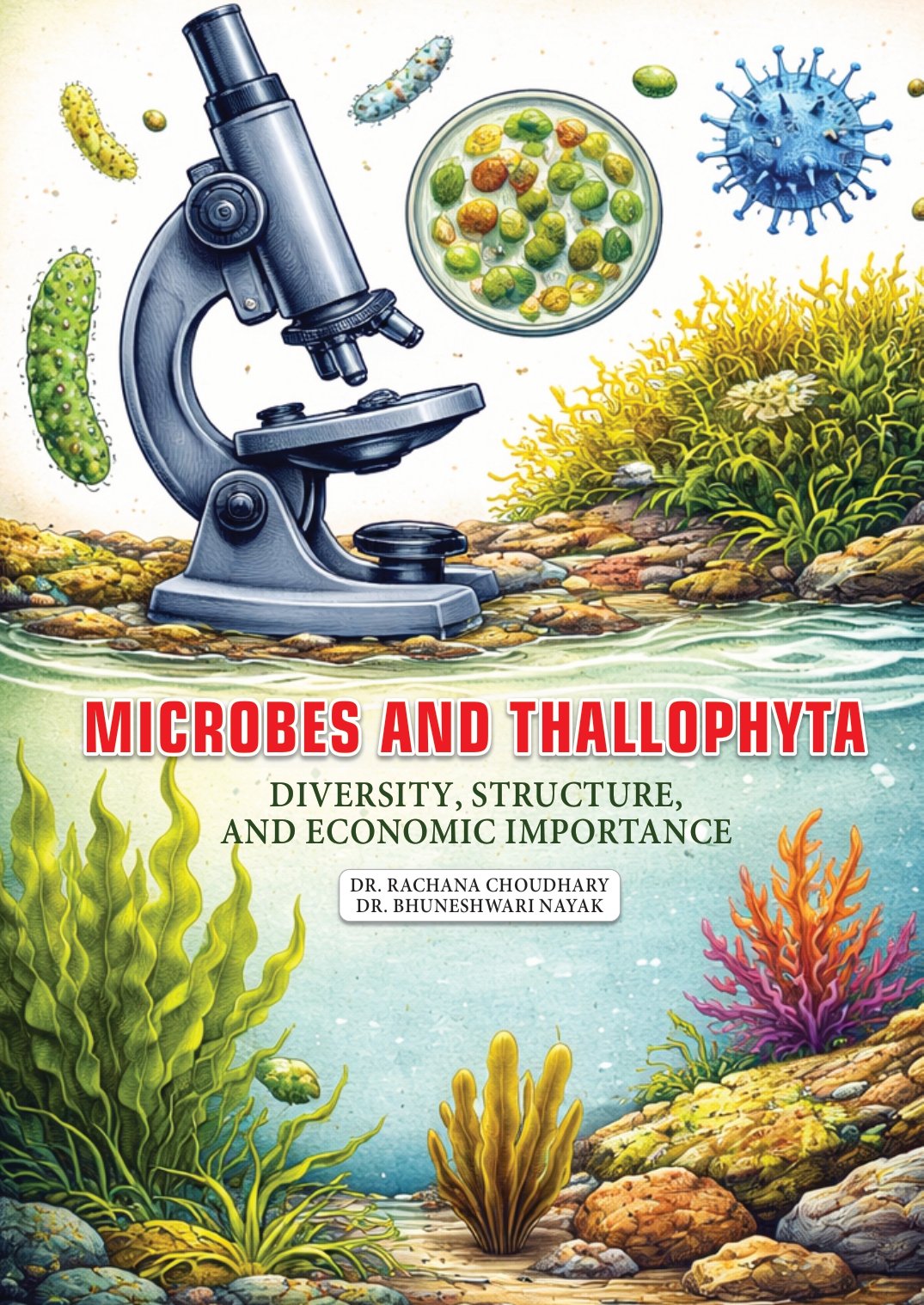
Microbes and Thallophyta: Diversity, Structure, and Economic Importance
Dr. Rachana Choudhary, Dr. Bhuneshwari Nayak
ISBN: 978-81-994642-1-6
Copyright: 2026
Binding Type: Perfect Binding
DOI: https://doi.org/10.63785/978-81-994642-1-6
About this Book
The world of living organisms is astonishingly diverse, ranging from the simplest unicellular forms to highly evolved multicellular organisms. Among these, microbes and thallophytes represent the most primitive and fundamental groups in the evolutionary hierarchy of life. Though often microscopic or structurally simple, they play crucial roles in the maintenance of life processes on Earth and serve as the foundation of ecological balance, nutrient cycling, and biotechnological innovation.
The term Thallophyta historically included organisms that lack a well-differentiated body structure into roots, stems, and leaves. These include algae, fungi, lichens, and bacteria, which, despite their simplicity, exhibit remarkable diversity in form, function, and habitat. Similarly, microbes-comprising bacteria, viruses, actinomycetes, and mycoplasmashave profound influence on all living systems. They participate in processes such as decomposition, fermentation, nitrogen fixation, and symbiotic
associations, making them indispensable to the biosphere.
Microbes: The Invisible Architects of Life
Microorganisms are omnipresent in soil, air, water, and within living beings. They are both beneficial and pathogenic, contributing to nutrient regeneration, food production, and biotechnology on one hand, and to disease and decay on the other. The development of microbiology as a scientific discipline began with Anton van Leeuwenhoek’s discovery of microscopic life (1675) and evolved through the pioneering works of Louis Pasteur, Robert Koch, and Alexander Fleming, who established the foundations of microbial science. Microbes are indispensable in agriculture as biofertilizers and biocontrol agents, in industry for producing antibiotics, enzymes, and fermented products, and in environmental management through waste decomposition and bioremediation. Their genetic adaptability and biochemical versatility have made them key players in modern biotechnology, medicine, and environmental sustainability.
Chapter 1: Viruses and Actinomycetes
Author: Dr. Rachana Choudhary
Volume: 01
First Online: 2026
Pages: 1-64
DOI:
Abstract […]
Chapter 2: Bacteria and Cyanobacteria
Author: Dr. Rachana Choudhary
Volume: 01
First Online: 2026
Pages: 65-112
DOI:
Abstract […]
Chapter 3: Phycology (Algae)
Author: Dr. Bhuneshwari Nayak)
Volume: 01
First Online: 2026
Pages: 113-195
DOI:
Abstract […]
Chapter 4: Mycology, Lichenology, and Mycorrhizae
Author: Dr. Bhuneshwari Nayak)
Volume: 01
First Online: 2026
Pages: 196-282
DOI:
Abstract […]