
Fundamentals of Plant Science and Ethnobotany (Elementary Botany)
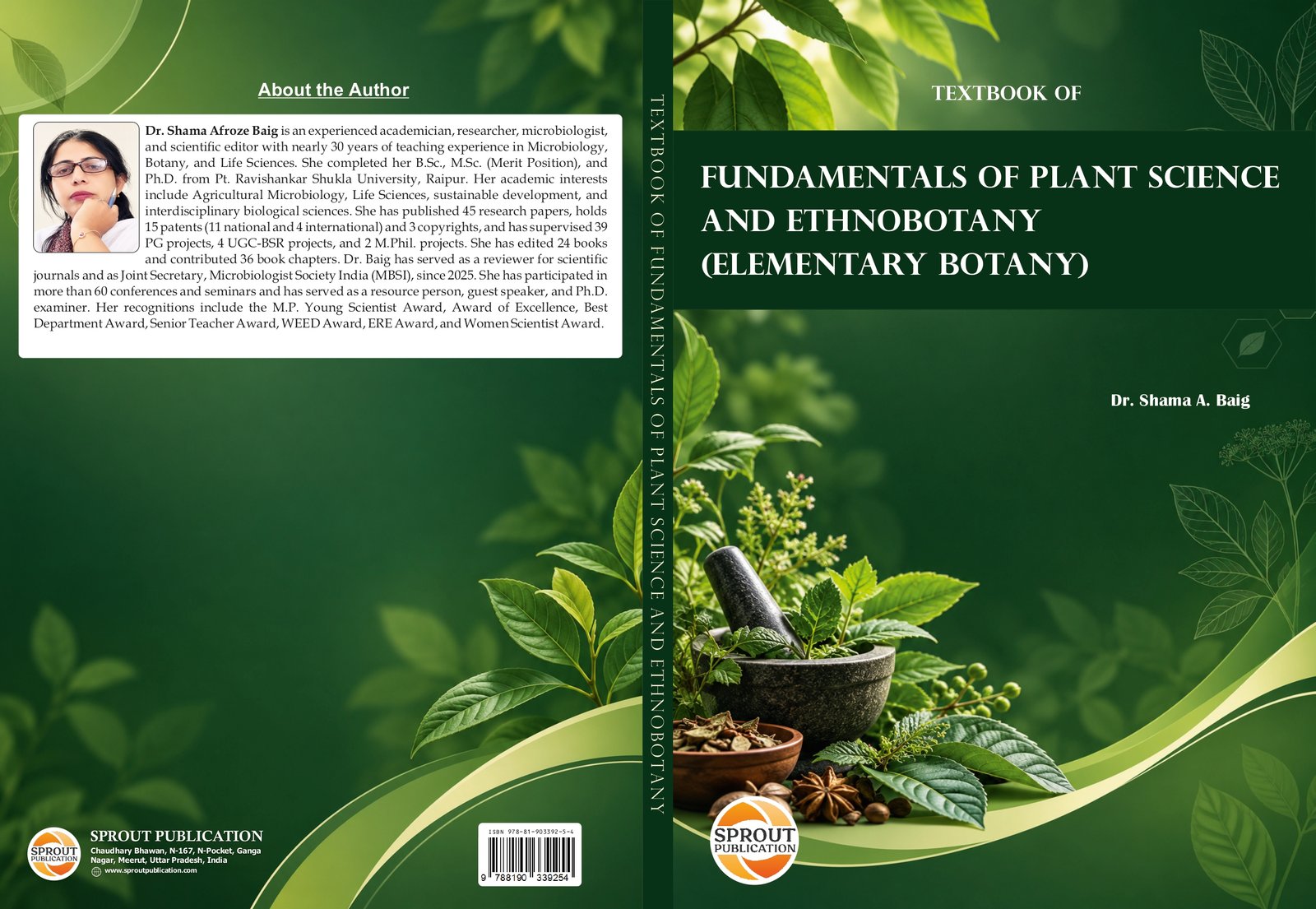
Fundamentals of Plant Science and Ethnobotany (Elementary Botany)
Author(s): Dr. Shama A. Baig
ISBN: 978-81-903392-5-4
Binding Type: Perfect Binding
Book Type: Authored Book
Book ID: SPBOOK85
Product Description
Plants are among the most fundamental components of life on Earth. They provide food, medicines, oxygen, fibres, timber, fuel, ecological services, and countless raw materials essential for human civilization. The study of plants therefore extends far beyond their structure and classification; it encompasses their physiology, ecology, diversity, economic importance, medicinal value, cultural significance, and relationship with human societies. Fundamentals of Plant Science and Ethnobotany has been developed with this broad perspective to provide undergraduate students with an integrated and accessible introduction to Plant Science and the traditional knowledge associated with plants.
The book has been designed particularly for undergraduate students of Botany, Life Sciences, Biotechnology, Microbiology, Environmental Science, and related disciplines, with an emphasis on conceptual clarity, scientific understanding, and practical relevance. It introduces students to fundamental aspects of plant biology while highlighting the close relationship between plants, people, culture, health, livelihoods, and the environment.
A distinctive feature of this book is its integration of Plant Science with Ethnobotany. Ethnobotany provides an important bridge between biological sciences and traditional knowledge by documenting how communities identify, utilize, conserve, and manage plant resources. India, with its remarkable floristic diversity and rich cultural heritage, possesses an enormous body of traditional knowledge concerning medicinal, edible, aromatic, fibre-yielding, timber, and other useful plants. Understanding this knowledge can provide valuable insights into biodiversity conservation, sustainable resource utilization, rural livelihoods, and the discovery of potential plant-based resources.
The book introduces students to important areas of Plant Science, including plant and animal cells, plant structure and organization, plant physiology, ecology, taxonomy, phytochemistry, phytopathology, plant biotechnology, economic botany, ethnobotany, forestry, and plants for human welfare. These topics are presented in a structured manner to help students understand both the fundamental concepts and their applications.
The chapters dealing with ethnobotany and medicinal plants emphasize the importance of documenting traditional knowledge systematically. Students are introduced to medicinal plants used for common health conditions, plant resources supporting rural livelihoods, ethnobotanical methods, ethnomedicine, ethnoecology, and the conservation and sustainable utilization of medicinal plants. Particular attention is given to resources such as Mahua, Tendu, Bamboo, and other culturally and economically important plants.
The book also introduces students to India’s ancient medicinal traditions, including Ayurveda, Siddha, and Unani. Classical concepts such as Panchamahabhuta, Tridosha, Saptadhatu, Rasayana, Mukkuttram, Mizaj, and Akhlat are presented within their appropriate historical and traditional contexts. The Charaka Samhita is discussed as an important Ayurvedic text containing extensive knowledge concerning health, medicinal substances, and plant resources. At the same time, the book encourages students to distinguish traditional concepts from modern scientific explanations and to appreciate the importance of scientific validation.
Another important theme is the contribution of Indian scholars and scientists to Plant Science. The intellectual journey from traditional medicinal knowledge to modern experimental Botany is illustrated through the contributions of Charaka, Jagadish Chandra Bose, B. P. Pal, T. V. Desikachary, K. C. Mehta, and M. S. Swaminathan. Their work demonstrates the diverse dimensions of plant science, ranging from medicinal plant knowledge and plant physiology to phycology, plant pathology, genetics, crop improvement, food security, and sustainable agriculture.
Modern scientific approaches are incorporated throughout the book wherever appropriate. Taxonomic authentication, phytochemical analysis, molecular identification, DNA barcoding, plant biotechnology, conservation biology, and sustainable utilization are discussed as tools for strengthening the scientific study of plant resources. Traditional knowledge is presented as an important source of information and research leads, while scientific investigation provides methods for authentication, validation, safety assessment, standardization, and conservation.
Each chapter has been structured to support undergraduate learning through clear subheadings, explanatory paragraphs, tables, conceptual diagrams, examples, review questions, multiple-choice questions, short-answer questions, and long-answer questions. These features are intended to make the book useful not only for classroom teaching but also for self-study, revision, assignments, examinations, and introductory research activities.
I hope that Fundamentals of Plant Science and Ethnobotany will serve as a useful academic resource for undergraduate students and educators and will encourage learners to explore the fascinating relationship between plants, people, science, traditional knowledge, and the environment. It is also hoped that the book will inspire students to appreciate India’s rich botanical heritage while developing a scientific and responsible approach toward its conservation and utilization.







Reviews
There are no reviews yet.